
Ever wonder why you’ll scroll past a polished, high-budget commercial in half a second, but somehow find yourself glued to your screen watching a guy slow-mo popping water balloons or a 45-minute video of someone dishwashing?
It’s not random, and it’s definitely not luck. It comes down to a fundamental truth about human psychology: we don’t lose interest because content is long; we lose interest because we run out of questions.
If you create content, design graphics, or market a brand, you’ve probably heard the endless warnings about shrinking human attention spans. But the secret to keeping an audience hooked isn’t making everything a 3-second soundbite. It’s understanding how to build tension, manage the “Curiosity Gap,” and deliver a payoff that feels earned.
Let’s break down how attention actually works and how you can use storytelling mechanics to keep people hooked.
The Curiosity Gap: The Void Between Knowing and Wanting to Know
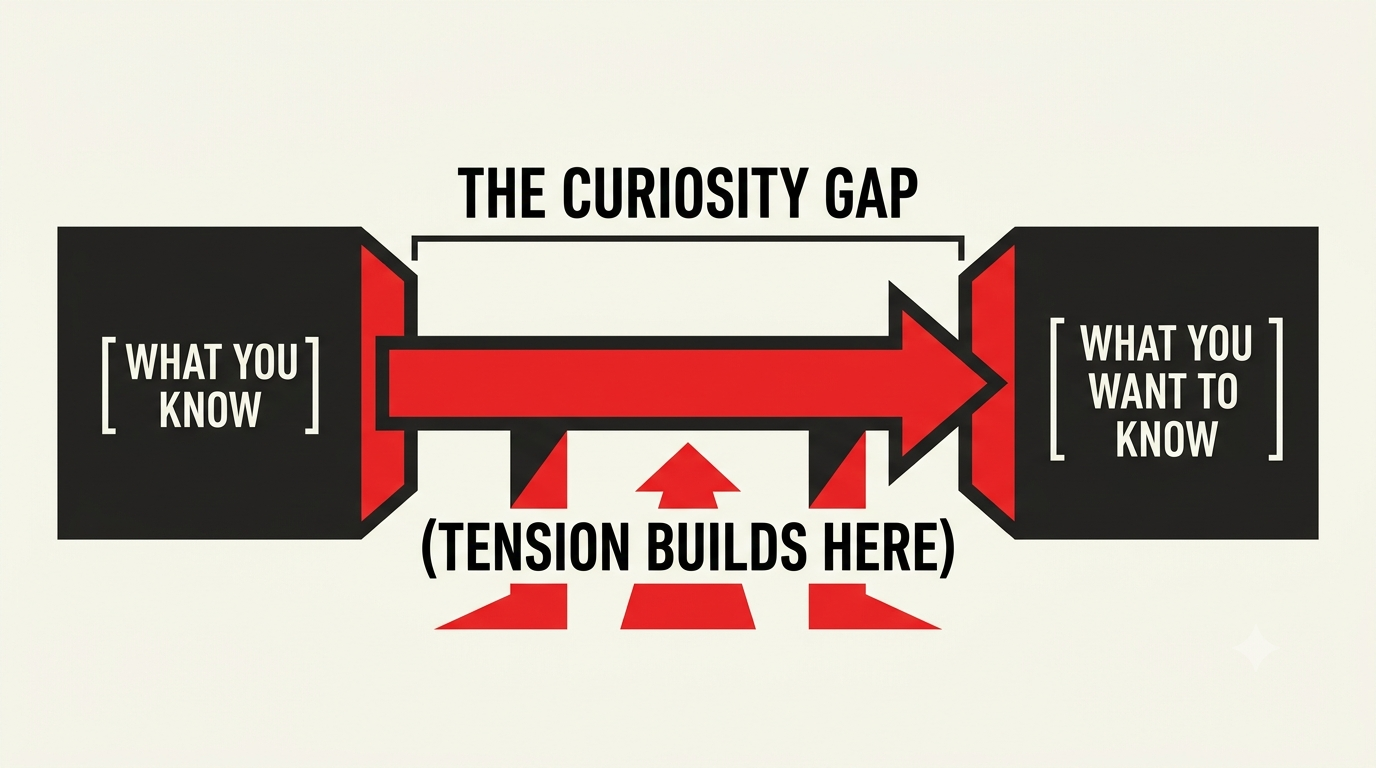
At the heart of every piece of content that grabs you is a concept popularised by author and speaker Andrew Davis: The Curiosity Gap.
The Curiosity Gap is the psychological void between Point A (What You Know) and Point B (What You Want to Know).
Human brains crave closure. When we recognize a gap in our knowledge, it creates an uncomfortable psychological itch—a state of tension! The only way to scratch that itch is to keep watching, reading, or listening until we get to the answer.
The Tale of Two Tech Reviews: The Foldable Phone Test
To see the Curiosity Gap in action today, look at how two modern tech creators approach the exact same premise—testing the durability of a $2,000 folding smartphone.
1. The Quick Payoff (YouTube Short / TikTok)
- The Format: A creator posts a 15-second vertical video.
- The Execution: “Can this $2,000 phone fold 100,000 times?” Cut straight to a machine rapidly slamming the screen open and shut, set to trending audio. At second 12, the screen snaps in half with a dramatic sound effect.
- The Audience Behavior: It’s visually striking and gives an immediate answer, but viewers scroll away immediately to the next video. Zero tension, zero investment.
2. The Tension Build (MrBeast or JerryRigEverything Live)
- The Format: A long-form livestream or structured endurance challenge.
- The Execution: A continuous live counter tracks every single fold in real time. Two presenters sit at a table, manually folding the phone, tracking micro-creases, listening for small cracks, and taking audience bets in the chat at every 10,000-fold milestone.
- The Audience Behavior: Tens of thousands of viewers stay tuned in for hours. Why? The device could break on fold #12,000, or it might hold until #80,000.
Why the Tension Build Wins the Engagement Game
Community Co-Creation: Every mechanical creak, delay, or close-up inspection turns the waiting room into an event, making the audience feel like co-witnesses to the climax rather than passive consumers.
The Immediate Answer Kills Curiosity: The short clip satisfies interest instantly. Once you know the outcome, your brain closes the loop, and you move on.
Micro-Stakes Expand the Gap: The endurance stream stretches the space between [ WHAT YOU KNOW ] (the phone is fine right now) and [ WHAT YOU WANT TO KNOW ] (at what exact moment does it shatter?).
The Physics of Engagement: The Attention Formula
When people say, “Your content is too long,” what they’re actually saying is, “I don’t have any more questions.”
To keep your audience from walking away, you have to manage the relationship between Tension, Time, and Payoff. You can even think of it as a formula:
$$\text{Attention} = \left(\frac{\text{Tension}}{\text{Time}}\right) \times \text{Payoff}$$
Here is how those elements balance out in practice:
- Spike Tension Quickly: If you take too long to build tension, the audience leaves before the curiosity gap even forms.
- Give Breathing Room: You can’t keep the tension at a 10/10 every second, or people burn out. Like a reality TV editor, build the stakes, give the audience a moment to breathe, and then raise the stakes again.
- Delay the Reveal: The biggest mistake creators make is giving away the answer too early. If you resolve the mystery in the first minute, the curiosity gap closes, the tension drops to zero, and the viewer leaves.
- Deliver a Proportional Payoff: The reward at the end must match the amount of tension you built. If you make someone wait through 10 minutes of buildup for a weak, disappointing answer, they’ll feel cheated. High tension requires a high-value payoff.
How to Think Like a Content Director
Whether you are writing a blog post, designing a campaign, making a video, or building a brand story, you can apply these same storytelling mechanics.
Before you launch your next project, ask yourself these core questions:
1. What does the user want?
What is the ultimate answer or goal they are seeking? This sets your Point B—what they want to know.
2. What threatens the user?
What stands in their way? What problem, misunderstanding, or obstacle creates the stakes? Tension doesn’t exist without stakes.
3. Where is the reveal?
Are you giving away the resolution in the first headline, or are you guiding the audience through a journey where they actively participate in finding the answer?
Move From “Want to Know” to “Need to Know”
Great content takes an audience from a casual state of curiosity (“That looks interesting, I want to know more”) and elevates it into a genuine need for closure (“I cannot close this tab until I see how this ends”).
By opening a clear curiosity gap, delaying the reveal, and balancing your tension over time, you stop fighting against short attention spans and start giving your audience exactly what their brains are wired to look for.
What’s a piece of content that unexpectedly held your attention for way longer than it should have?