
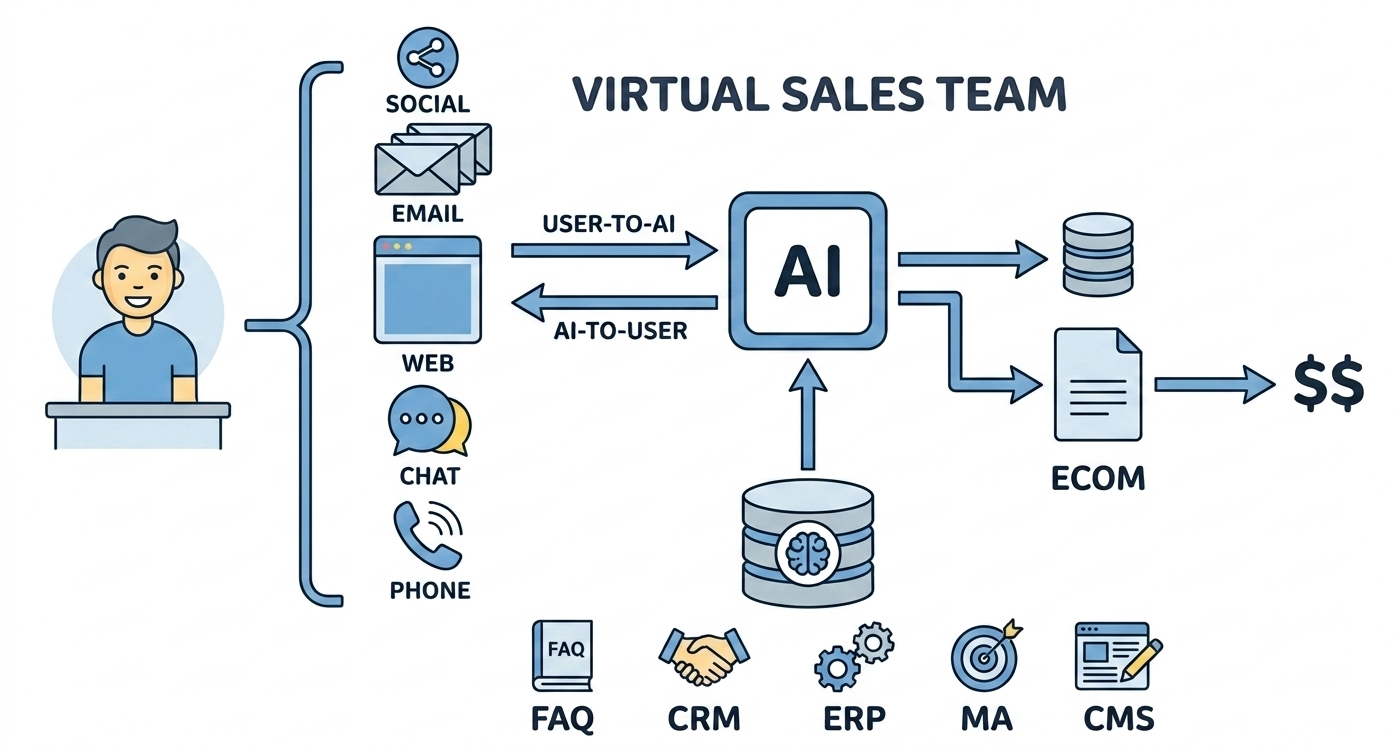
Imagine having a sales force that works around the clock, speaks every regional dialect your customers use, never gets fatigued by surprise questions, and seamlessly connects every customer touchpoint straight into your backend operations.
It sounds like a futuristic dream, but at blindog.com, it’s the exact concept taking center stage in modern digital strategy: the 100% Virtual Digital Sales Team.
Whether you run a growing e-commerce brand or an established enterprise, understanding how Artificial Intelligence (AI) can bridge customer interactions with operational execution is the key to unlocking consistent revenue growth. Let’s break down how this digital sales ecosystem works, why it matters, and how it transforms the customer journey.
The Core Concept: Connecting Front-End Engagement to Back-End Results
At its heart, the idea is simple. A potential customer reaches out through whatever channel they prefer—social media, email, website forms, live chat, or phone calls. In a traditional setup, these incoming messages might sit in an inbox for hours or land on different department desks, leading to delayed responses, lost leads, and frustrated buyers.
With an integrated AI digital sales team:
- Multi-Channel Input: Customer inquiries stream in simultaneously across Social Media, Email, Websites, Live Chat, and Phone / Voice.
- Centralized AI Brain: An intelligent AI core processes these incoming interactions in real time.
- Data Integration: The AI pulls information from and updates your core business systems—such as your customer databases, inventory records, and content hubs.
- Action & E-Commerce Execution: The system provides helpful answers, guides customers through their purchasing decision, and routes orders directly through your E-Commerce (ECOM) platform, generating bottom-line revenue.
Defining the Acronyms: Your Business Tech Stack Simplified
To make this seamless connection work, the AI integrates with several critical back-end systems. While these tools are standard in modern business, their acronyms can often feel like alphabet soup. Here is what each acronym stands for and how it fits into the Virtual Sales Team model:
- FAQ (Frequently Asked Questions):
A centralized repository of common customer inquiries and official answers. The AI references this knowledge base to answer routine questions instantly—such as store hours, shipping policies, or return rules. - CRM (Customer Relationship Management):
Software used to track and manage all interactions with leads and current clients. When a customer interacts with your digital sales team, the interaction history, preferences, and contact information are saved directly into your CRM. - ERP (Enterprise Resource Planning):
Business management software that coordinates key operations like stock inventory, supply chains, orders, and accounting. Connecting AI to your ERP ensures the sales team always knows real-time stock levels, pricing, and fulfillment schedules. - MA (Marketing Automation):
Platforms that handle automated marketing tasks, such as sending follow-up email campaigns, nurture series, or promotion alerts. The virtual sales team feeds customer behavior data into your MA tool to deliver timely, targeted follow-ups. - CMS (Content Management System):
The platform hosting your website content, product descriptions, blogs, and media files. The AI accesses your CMS to share up-to-date marketing material, specs, or product guides directly with shoppers. - ECOM (E-Commerce):
Your online store platform where payments are processed and transactions are finalized. The AI guides shoppers straight into your ECOM checkout to complete transactions smoothly.
Key Features of Your Digital Sales Squad
What makes a virtual digital sales team feel human, trustworthy, and effective rather than robotic and frustrating?
1. 24/7 Instant Responses
Customers expect instant answers, day or night. A virtual team never sleeps, ensuring that a late-night inquiry convert into a sale immediately rather than cooling off by morning.
2. Multiple Distinct Personas
Instead of a single generic chatbot, your virtual team can embody distinct personalities designed for different customer segments or stages of the buyer journey. Whether your brand identity calls for a friendly guide named Steve, an analytical advisor named Bill, or customer advocates like John, Mark, and Mary, each persona brings a consistent tone and tailored approach.
3. Regional Languages and Dialects
Global reach requires local understanding. The virtual team dynamically adapts to regional languages, idioms, and local dialects, making every customer feel understood and comfortable regardless of where they are contacting you from.
4. Hybrid Expertise: Sales, Service, & Technical Knowledge
Traditional teams often suffer from silos—sales reps don’t know technical specs, and support agents don’t know how to close a deal. The AI digital sales team combines high-touch sales capability, helpful customer service, and deep technical expertise into a single cohesive capability.
5. Smart Enough for “Curveball” Questions
Shoppers rarely follow a strict script. They ask unusual comparison questions, mention edge-case requirements, or bring up unexpected needs. Powered by advanced AI models, your virtual sales team handles unpredictable questions smoothly, maintaining context and delivering accurate responses without hitting a dead end.
Flexible Business Models for Implementation
Adopting a virtual digital sales team doesn’t require a massive upfront risk. Flexible, tiered structures designed to scale alongside your business growth work best:
- Freemium & Entry Tiers:
- Free Tier: Ideal for small businesses getting started—offering support for under 100 customer engagements across a single channel at zero cost to trial the solution.
- Tiered Pricing: As your organization grows, pricing scales transparently based on the number of engagements, active communication channels, custom personas, or hourly usage.
- Professional Services & Setup:
- Expand Channels and Engagements: Add more customer channels and engagements to tiers right sized for your company.
- Setup & Customization: Onboarding expertise to configure your AI, build unique team personas, and map workflows.
- Maintenance Contracts: Ongoing monitoring, optimization, and system updates to ensure optimal performance.
- Analysis & Reporting: In-depth periodic reporting to give you clear visibility into conversation metrics, conversion rates, and customer sentiment.
- Performance & Commission Models:
- Percentage of Sales: Align incentives directly with results through a modest transaction fee (typically 15–25%) on sales successfully assisted or closed by the virtual sales team.
The Bottom Line: Your Best Sales Rep, Multiplied
A virtual sales team isn’t meant to replace the human touch—it’s designed to multiply it. By taking over repetitive inquiries, managing multi-channel lead routing, and providing instant around-the-clock responses, your virtual sales team operates like your best salesperson on their best day, every single day.
Ready to transform how your business connects with customers, captures leads, and drives e-commerce revenue? Explore more insights and solutions by reaching out to blindog.com.