
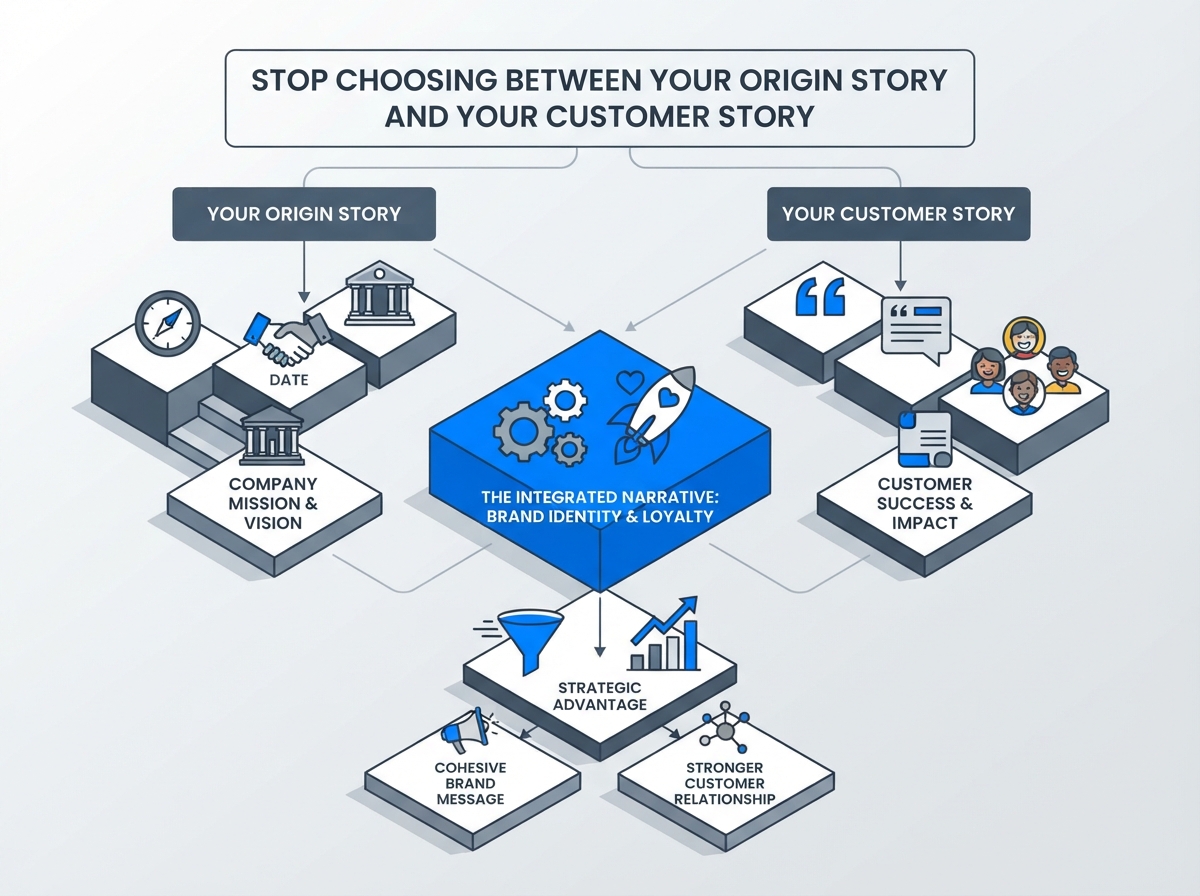
Scroll through any B2B channel on any given morning, whether it’s a social feed, your inbox, or a conference agenda, and you’ll see two kinds of content.
The first is the founder confession. “I was down to my last dollar. My co-founder quit. I slept in the office.” Fifteen line breaks later, there’s a lesson about grit.
The second is the customer case study. “Company X increased efficiency by a big percentage after adopting our platform.” It reads like a procurement form somebody dressed up with a logo.
Both are everywhere. Both are mostly ignored and the argument over which one to run misses the point.
The Fight Nobody Needs to Win
Founder stories without the customer in them are self-indulgent. Your buyer has a problem on their desk right now, and your struggle to make payroll isn’t it.
Customer stories without a point of view are commodity proof. Any competitor can publish a before-and-after chart. When every vendor has one, the chart tells nobody why you.
Each approach fails alone. Together, they work.
Who You’re Actually Talking To
Here’s the idea that should change how you plan your content. At any given moment, almost your entire market isn’t buying. Only a thin sliver of buyers is ready to act today.
That splits your job in two:
- The vast, quiet majority aren’t comparing vendors. They won’t read a spec sheet. What you can do is make sure that when a need finally shows up, your name is the one that comes to mind. That takes emotional resonance, repeated over a long stretch of time.
- The small group ready to buy is looking for proof right now. They want evidence that you can do what you say.
Your origin story builds memory with the first group. Your customer story closes the second. Run only one and you’re either ignoring nearly everyone or leaving ready buyers without proof.
Why Story Beats Stats (and Why Stats Still Matter)
People forget numbers almost instantly. A lone statistic or technical feature slips out of most heads within minutes. A story built on conflict, transformation, and stakes sticks, and most people can retell it days later.
So the sterile case study isn’t just boring. It’s forgettable by design.
But don’t swing too far the other way. Buyers want substance. The overwhelming majority say the thing that matters most is a partner who understands their business challenges, and most also want real domain expertise. Playing it safe ranks well below both.
Buyers aren’t looking for comfort. They’re looking for someone who gets it. A story shows you get it. Proof shows it’s real. Campaigns that pair emotional framing with rational proof, built around one clear promise to the customer, drive stronger commercial results and hold market share growth over several years.
Story and proof aren’t rivals. You need both.
The Trust Problem You’re Walking Into
Nearly every buyer calls brand trust non-negotiable. Sounds great, until you read the rest of the finding. Most of those same buyers guard their trust tightly. They wave off polished corporate messaging and lean on peers and credible human leaders instead.
Your brand page won’t win that trust. A founder with a real conviction might. A customer who’ll say, in their own words, what it cost them to change might even more.
That’s why the two stories belong together.
The Shared Crucible Narrative
Here’s the model: the founder isn’t the hero, and the customer isn’t a case study.
The founder becomes a cartographer. They’ve spotted a flaw in how the industry works, one that costs everybody time or money and that nobody’s fixing. Their origin story isn’t “look what I overcame.” It’s “look what I found, and why it wouldn’t leave me alone.”
The customer becomes a frontier pioneer. They’re the one who took the risk, pushed against their own organization, and tested the thesis in the real world. Their story is the validation chapter of the founder’s quest.
Same narrative. Two voices. One argument.
Step 1: Rebuild the origin story around the flaw
Take your founder story and remove every line that exists only to make the founder look good. Then ask:
- What broken thing in the industry did you see that others kept accepting?
- Who was getting hurt by it?
- Why did it matter enough to build a company around?
Think of it as a mentor’s ledger. You’re recording what you learned about the industry’s failure, not keeping score of your own sacrifices. If a sentence doesn’t help your buyer see their own problem more clearly, cut it.
Step 2: Rebuild the case study around the rebel
Stop leading with the metric. Lead with the resistance.
- What did your customer’s team push back on?
- What did they risk by trying something new?
- What was at stake if it failed?
- Then, and only then, what changed?
The numbers matter, and they belong in the story. They just land harder once the reader feels the stakes. Conflict, transformation, stakes: that’s the structure people remember.
Step 3: Connect them out loud
Don’t leave readers to guess how the chapters fit. Say it: “We saw this flaw. We thought the fix was X. [Customer] was brave enough to test it. Here’s what happened.”
A Simple Rhythm for Any Channel
You don’t need a complicated calendar, and you don’t need to be on every platform. You need three kinds of content and a few different people behind them. Where they run is up to you.
Category origin content comes from the founder. It’s about the flaw you spotted, not your hardship. It could be a social post, a newsletter essay, a podcast episode, a keynote opener, or the story on your About page. This is how you reach the quiet majority.
Insight content comes from your executive team. It shares a sharp observation about how the industry works and where it goes wrong. Think blog articles, webinars, panel talks, short videos, or a recurring email series. This builds your point of view and keeps you in the conversation between buying cycles.
Customer proof content comes from your customer advocacy program, ideally with the customers themselves involved. Think customer-led talks, video interviews, long-form stories on your site, sales decks, and follow-up emails to active prospects. This serves the buyers who are ready to decide.
Here’s one way to pace it across whatever mix of channels you use:
- First 30 days: Lead with category origin. Establish the flaw and your worldview everywhere your audience already pays attention. Add one or two insight pieces. Hold the proof back for now.
- Days 31 to 60: Keep the founder voice going, but start introducing customers as people working on the same problem. Tell the early chapters of their stories.
- Days 61 to 90: Bring in full customer journeys, framed as the validation of what you’ve been saying. Now the proof has context, and the context has proof.
Then repeat, with new flaws and new pioneers.
Match the format to the channel, but keep the story the same. A founder’s origin might be a two-minute video in one place and a 1,500-word essay in another. If the thread is consistent, buyers who meet you in three places will recognize one idea, not three campaigns.
Treat this as a starting point and adjust it to where your audience actually spends time.
The Takeaway
Stop asking whether you should tell your story or your customer’s story.
Tell the story of a problem worth solving, from the person who spotted it, validated by the person who bet on the fix. Do that, and you’re speaking to the many who’ll buy later and the few who’ll buy now.
One narrative. Two audiences. Every channel.